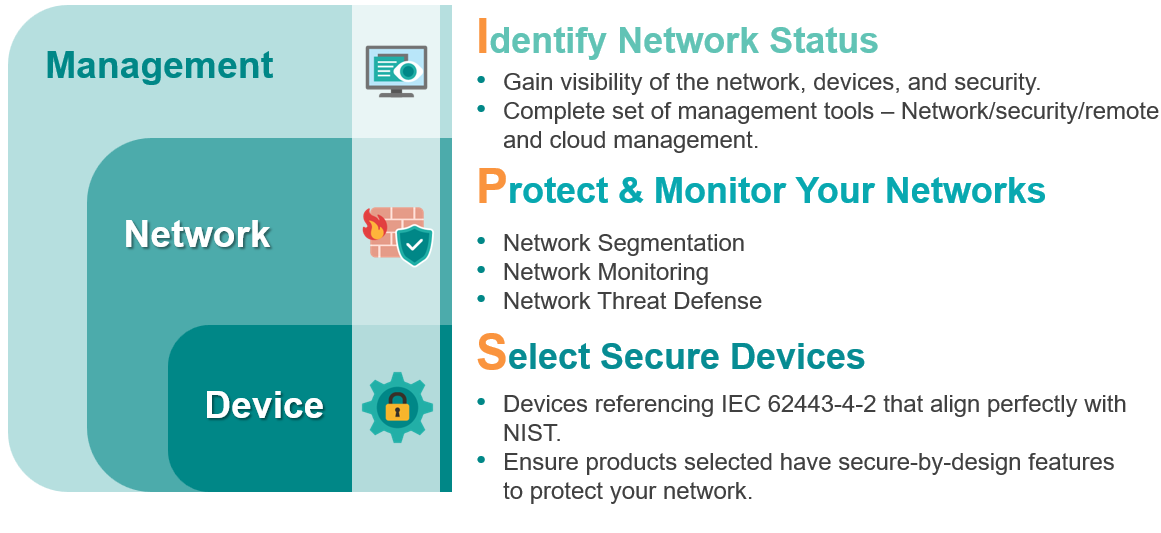
Companies are required to deploy security measures to enhance visibility and response capabilities.
Under the Cyber Incident Reporting for Critical Infrastructure Act (CIRCIA), critical infrastructure organizations must report significant cyber incidents and ransomware payments to the Cybersecurity and Infrastructure Security Agency (CISA).
Ensure your team is prepared and compliant with evolving federal requirements.
Risk comes from both vertical and horizontal movement.
Vertical:
Establishing effective monitoring checkpoints remains a challenge, particularly in environments assumed to be air-gapped. In many cases, IT assessment teams have successfully accessed OT networks through overlooked or unintended connections, revealing critical blind spots in network architecture and security oversight.
Horizontal:
When network topologies lack clear segmentation between user, production, and critical systems, organizations face heightened cybersecurity risks. Specifically, the increased likelihood of lateral attacks that can disrupt operations and compromise sensitive assets.
Diverse assets and devices make security even more challenging.
- OT environments are typically composed of a diverse mix of devices, sensors, controllers, and software from multiple vendors, resulting in complex, diverse systems that are challenging to manage, secure, and standardize effectively.
- Many industrial facilities continue to operate with legacy control systems that lack built-in security, leaving them increasingly exposed to modern cyber threats and undermining overall operational resilience.
- The increasing adoption of cloud services and internet connectivity within OT environments, if not appropriately done, significantly expands the attack surface, introducing new vulnerabilities that require proactive security measures.
04 - The Necessary Evil of Building the Industrial IoT
The Industrial Internet of Things (IIoT) aims to increase productivity and make users lives easier. However, this can only be achieved when the Industrial IoT environment has reliable network connectivity. An unreliable network presents users with several
challenges including: longer system downtime, cyber security risks, and unstable operations, especially when using a wireless connection. The diagram below uses factory automation as an example to illustrate what kind of concerns our industry partners
face when trying to adopt lndustrial loT applications and benefit from them.

05 - The Necessary Evil of Building the Industrial IoT
The Industrial Internet of Things (IIoT) aims to increase productivity and make users lives easier. However, this can only be achieved when the Industrial IoT environment has reliable network connectivity. An unreliable network presents users with several
challenges including: longer system downtime, cyber security risks, and unstable operations, especially when using a wireless connection. The diagram below uses factory automation as an example to illustrate what kind of concerns our industry partners
face when trying to adopt lndustrial loT applications and benefit from them.